


TL;DR - 30-second summary
Three days ago, Google published its first official guide on how to appear in AI answers. What's revealing isn't what it recommends, but what it dismantles. If you pay (or are thinking of paying) for an “AEO” or “GEO” package, read it before signing.

The SEO for Generative AI This week, it stopped being theory. Three days ago, Google published its first official guide on how to appear in AI Overviews and AI Mode, those AI-generated answers that are increasingly replacing the usual blue links. If you are paying for or considering paying for an “AEO” or “GEO” package, trendy acronyms in the industry, you should read this before signing.
What changed this week (and why no one expected it to come from Google)
On May 15, Google Search Central published Optimizing Your Website for Generative AI Features on Google Search. This is the first time they have formally spoken about SEO for generative AI. Until then, everything was speculation: blogs, Twitter threads, gurus selling courses on how to “optimize for ChatGPT,” “for Perplexity,” or “for Gemini.”.
The funny thing is what the document No It does not announce a new system. It does not publish unpublished metrics. It does not open a special dashboard.
What it does is dismantle, one by one, the tactics that were sold as the new SEO since generative answers arrived. And that's where it gets interesting.
The industry that was built in six months
Since AI Overviews appeared, a whole new layer of services has emerged, marketed under the label of generative AI SEO:
- AEO (Answer Engine Optimization) Packages
- GEO (Generative Engine Optimization) Packages
- “AI Readiness” Audits”
- Services to create llms.txt files
- LLM-compatible content rewriting“
- Purchase of mentions on blogs and forums for “AI citing you”
- Content fragmentation into small pieces, the famous chunking
Each with their own speech, their price, and their promise that you won't survive without it. The problem is that Google just put those tactics on a specific list. And the list isn't exactly an endorsement.
What Google Says You DON'T Need to Do
The guide has a section called Mythbusting generative AI search. Here we dismantle five generative AI SEO practices that circulate as absolute truths:
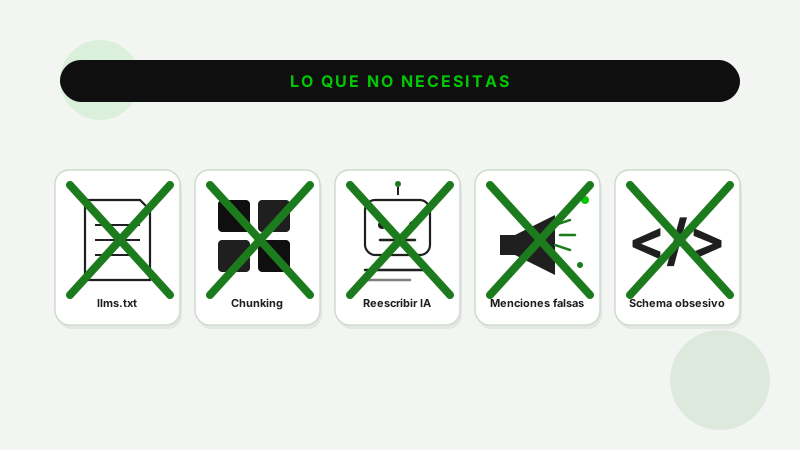
1. LLMs.txt files and “special markup”. You don't need them. Google explicitly says they are not required and does not give them special treatment.
Chunking content. Breaking texts into small pieces for AI to understand. Unnecessary. Their systems process the full page context.
3. Rewrite content specifically for AI. You don't need to change your wording to “talk to the model.” Systems understand synonyms, intent, and nuances.
4. Search for inauthentic mentions. Paying to be mentioned on blogs, forums, or discussions. Google blocks spam with the same systems that filter the rest of search.
5. Obsessing over structured data. There is no special schema.org for AI. The one you already use for rich results is still useful, but it's not the main lever.
Five tactics. Five “don'ts.” And if you take that off the table, what's left of SEO for generative AI? That's the question many agencies would prefer you didn't ask.
Generative AI SEO: What Actually Works
Google names three things as the actual recipe for generative AI SEO:
Unique content from personal experience. No “7 tips for...”, no summaries of what already exists on other blogs. Content that only you can write because you lived the experience, saw the problem, did the test. Google calls it Non-commodity content and considers it the most determining factor for visibility.
Clean technical structure. Crawlable, indexable, fast site. Semantic HTML where possible. Good mobile performance. Reduce duplicate content. The usual.
Local business and well-advertised product. Here Google is specific: it mentions Google Business Profile and Merchant Center as sources that directly feed generative answers. That's precisely where the Well-done local SEO Make a difference.
Three things. The same three things that serious SEO has been doing since before AI Overviews existed. The difference is that Google is now confirming it in writing.
The reason why this is convenient for you as a local business
Here's the generative AI SEO portion that will change your decision this week.
Google's generative responses do not invent information out of thin air. They use a technique called RAG, Retrieval-Augmented Generation. In simple terms: AI first searches Google's usual index, finds relevant pages, and then builds its answer based on what it found. If your site doesn't appear in traditional search, it won't appear in AI results. If your Google listing isn't optimized, it won't appear in the local responses AI generates.

This is why SEO for generative AI isn't a new discipline, it's the same old work with even more reasons to do it well. This means two concrete things for your business:
First, your investment in Local SEO and Google Business Profile doesn't become obsolete, it becomes more important. Every peso well-invested in optimizing your listing now works on two fronts at once: the traditional result and the generative response.
Secondly, if an agency charges you an extra package for “AEO” or “GEO” on top of normal SEO, they are charging you twice for the same job. Google just declared it official: SEO for generative AI is optimizing for search. It's the same thing.
How to use this to your advantage this week
If you already work with an agency: Ask them their stance on AEO and GEO. If they start selling you an additional package, you'll have something to respond with. If they tell you “the important thing is unique content, clean technique, and an optimized Google profile,” they are aligned with what Google has just confirmed.
If you drive yourself: Focus the limited time you have on what's confirmed, write from your real experience, keep your site fast and crawlable, and work on your Google Business Profile as if it were your main entrance. Because increasingly, it is.
If you are evaluating an agency for the first time, this guide gives you the best filter question: “What is your stance on GEO and AEO?” The answer tells you practically everything.

At UnEjemplo, we've been working on SEO for generative AI even before Google confirmed it in writing, not because it's a trend, but because it's what drives local clients' businesses. If you want to know how ready your business is, we'll tell you for free: We analyzed your website, your business listing, and your local positioning. and we'll show you with numbers what you're missing. If there's no work to do, we'll tell you that too.